
TBNC / Journal · Volume 001
MOTION
The Modern Highway
The road became more efficient. Somehow, that made its remaining mystery more valuable.
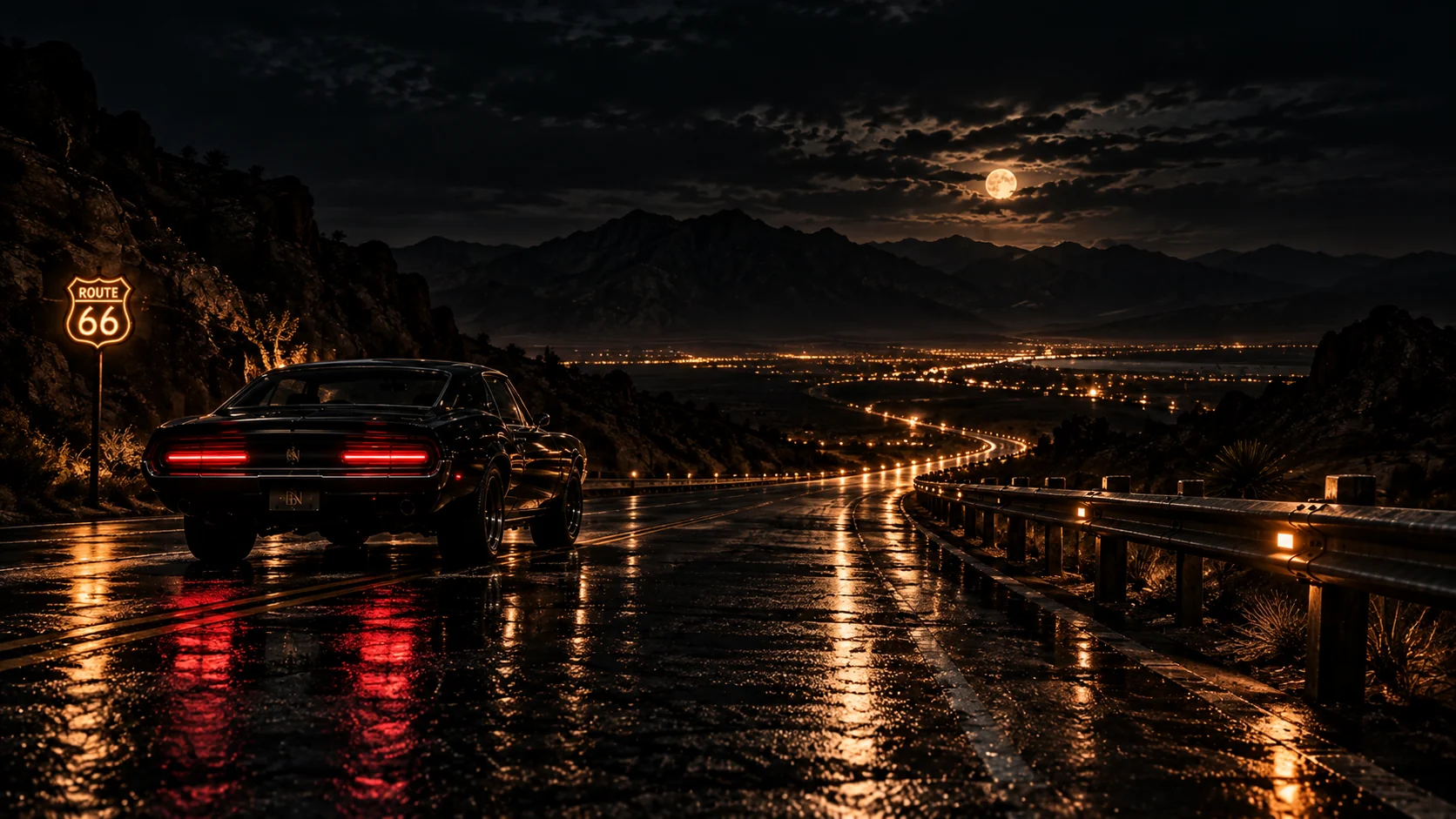
The modern highway is very good at removing decisions. Lanes are numbered, exits are announced early, fuel is mapped, arrival times are predicted, and a blue line can tell you which fork to take before the fork is visible. This is useful. It is also the opposite of mystery.
A road once carried uncertainty as part of the experience. You watched the light change, read the landscape, noticed the distance between towns, and understood that movement had consequences. Today, a trip can become a sealed passage between two addresses. Climate control, navigation, notifications, and scheduled stops make the world outside the glass feel almost decorative.
Still, the road resists complete domestication. Drive late enough and the systems begin to thin out. Traffic disappears. Storefronts go dark. The signs become less frequent. The cabin turns into a small moving room, and the highway becomes less like infrastructure and more like a line through darkness.
That is where music changes. A song heard at noon in a kitchen is not the same song at 1:17 in the morning with fifty miles of road ahead. Low frequencies feel larger. Repetition becomes useful. Silence between tracks becomes part of the trip. The windshield reflects the dashboard just enough to remind you that the inside and outside worlds are overlapping.
The road is most alive when it stops explaining where you are.
The attraction is not nostalgia for a less convenient time. Convenience is excellent. The attraction is the remaining pocket of uncertainty inside a system designed to eliminate it. A road can still create a temporary version of you with fewer roles attached. No desk, no room, no familiar chair, no expectation to perform the person you were earlier that day. Just direction, speed, sound, and whatever arrives in the mind when nothing else is asking for it.
That is why certain places along a highway matter beyond what they sell. A diner open later than it needs to be. A motel sign that has survived three redesign cycles. A gas station surrounded by more darkness than commerce. A rest area where the wind sounds louder because there are no buildings nearby. They are not destinations, but they interrupt efficiency long enough to make location real again.
The best road culture has always understood this. The machine matters, but not because motion is an end in itself. The car, the motorcycle, the bus, the truck, the train, all of them are devices for changing context. They move the body so the mind can temporarily lose its usual coordinates.
The modern highway may be optimized, monitored, resurfaced, and mapped down to the minute. It can still produce a rare thing: a stretch of time that belongs to nobody else. The road is most alive when it stops explaining where you are. Sometimes that is enough reason to keep driving.